ITSM & Incident Management Guide | ServiceNow Interview Prep
ITSM & Incident Management Guide | ServiceNow Interview Prep:
1. What is ITSM?
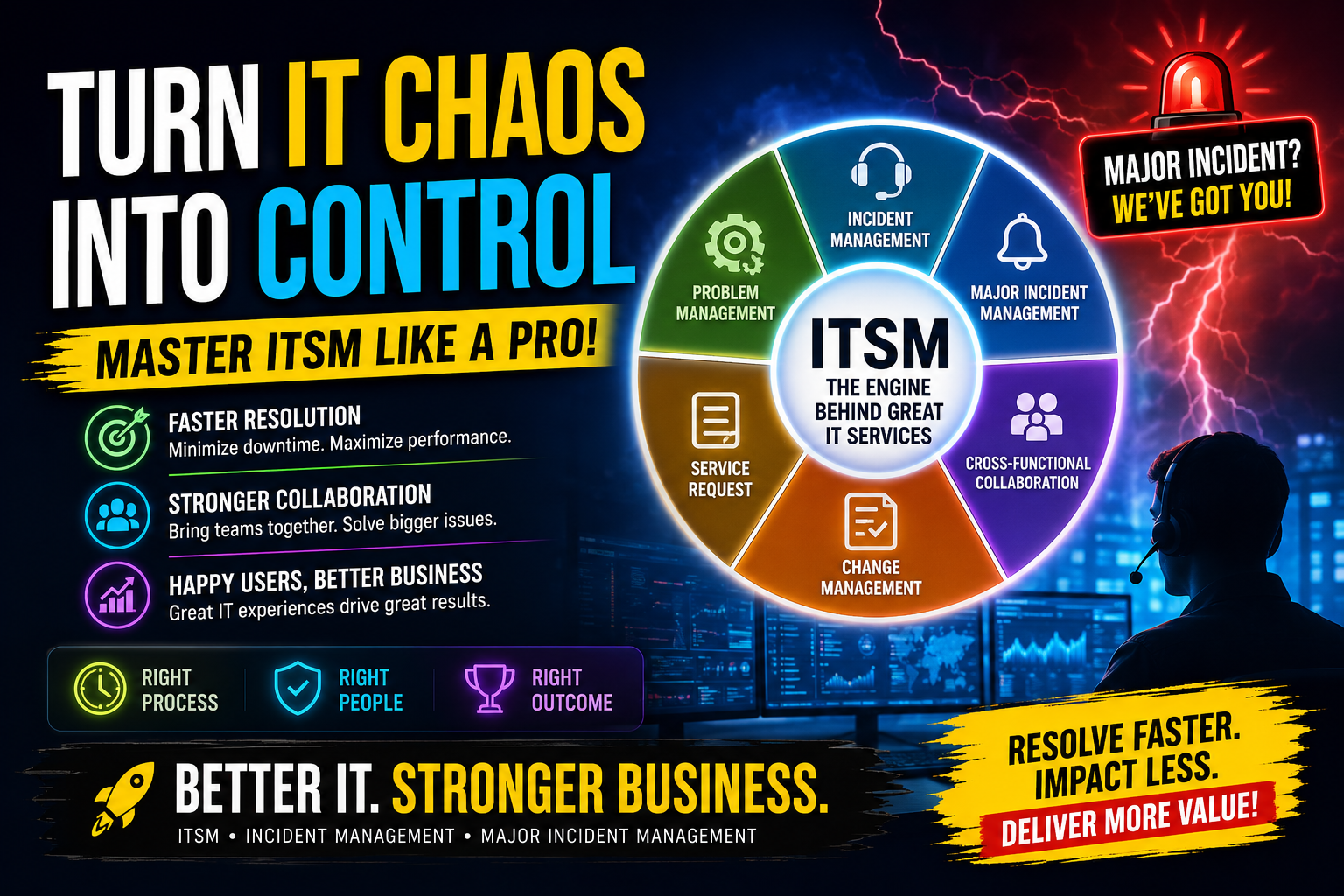
ITSM (IT Service Management) is the process of designing, delivering, managing, and improving IT services to meet business needs.
Simple Interview Definition
“ITSM is a framework used to manage IT services efficiently throughout their lifecycle. It ensures IT services are delivered, supported, and improved according to business requirements.”
Examples of ITSM Processes
- Incident Management
- Major Incident Management
- Problem Management
- Change Management
- Service Request Management
- Asset Management
- Configuration Management
Popular ITSM tools:
- ServiceNow
- BMC Remedy
- Jira Service Management
2. What is ServiceNow?
Definition
ServiceNow is a cloud-based ITSM tool used to manage incidents, requests, changes, assets, and workflows.
Interview Answer
“ServiceNow is an ITSM platform that helps organizations track and manage incidents, service requests, changes, and other IT operations through automated workflows and ticket management.”
Common Activities in ServiceNow
- Creating incidents
- Assigning tickets
- Updating work notes
- Escalations
- Change Requests (CRQ)
- Problem Records
- Reporting and Dashboards
3. What is Incident Management?
Definition
Incident Management is the process of restoring normal service operation as quickly as possible after an interruption.
Interview Definition
“Incident Management focuses on minimizing business impact by restoring services quickly whenever an unexpected issue occurs.”
Examples
- Server down
- Application unavailable
- Database connectivity issue
- Network outage
- Job failures
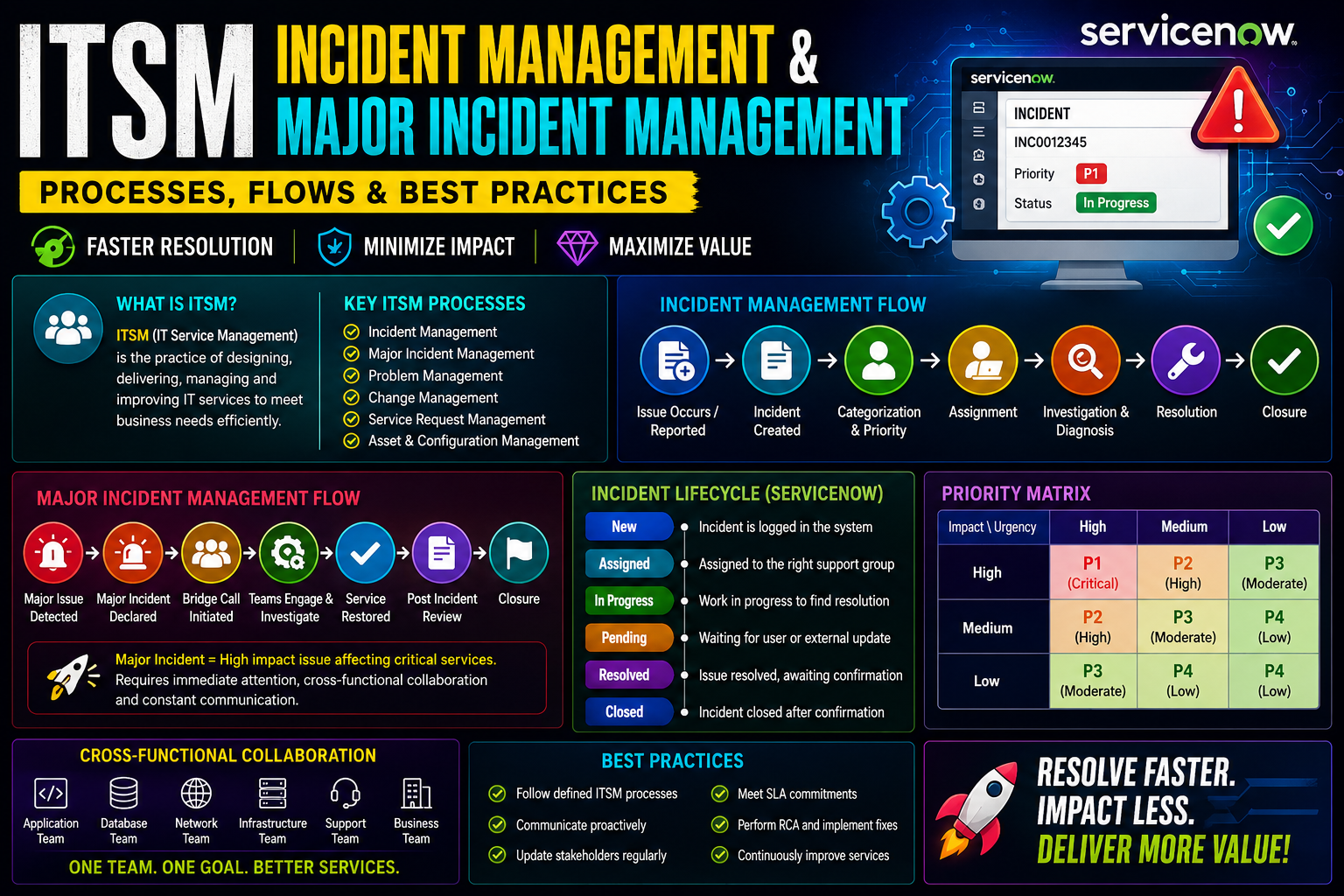
Incident Management Flow
Issue Occurs
      ↓
Incident Ticket Created
      ↓
Categorization & Prioritization
      ↓
Assignment to Support Team
      ↓
Investigation & Diagnosis
      ↓
Resolution Applied
      ↓
User Confirmation
      ↓
Ticket Closure
Incident Lifecycle
New
 ↓
Assigned
 ↓
In Progress
 ↓
Resolved
 ↓
Closed
4. What is a Major Incident?
Definition
A Major Incident is a high-priority incident that causes significant business impact and requires immediate attention.
Interview Definition
“A Major Incident is a critical service disruption affecting multiple users or business functions, requiring urgent resolution and coordinated communication.”
Examples
- Production application outage
- Banking payment system down
- Entire network outage
- Data center failure
Difference Between Incident and Major Incident
| Incident | Major Incident |
|---|---|
| Normal issue | Critical issue |
| Limited impact | High business impact |
| Standard process | Emergency process |
| Normal SLA | Accelerated SLA |
| Single team may resolve | Multiple teams involved |
Major Incident Management Flow
Major Issue Detected
          ↓
Major Incident Declared
          ↓
Major Incident Manager Assigned
          ↓
Bridge Call Started
          ↓
Technical Teams Engaged
          ↓
Root Cause Investigation
          ↓
Service Restored
          ↓
Business Communication
          ↓
Post Incident Review
          ↓
Closure
What is a Bridge Call?
Interview Answer
“A bridge call is a conference call initiated during a major incident where all support teams collaborate in real time to identify and resolve the issue.”
Participants:
- Incident Manager
- Application Team
- Database Team
- Network Team
- Infrastructure Team
- Business Stakeholders
5. What is Cross Functional Management?
Definition
Cross Functional Management is the coordination of multiple teams working together to resolve issues or deliver services.
Interview Definition
“Cross Functional Management involves collaboration between different technical and business teams to achieve a common objective or resolve complex incidents.”
Example
Application is down:
Application Team
       +
Database Team
       +
Network Team
       +
Server Team
       +
Business Team
       ↓
Issue Resolution
Interview Question:
How do you handle a Major Incident?
Sample Answer
“First, I verify the impact and severity of the issue. If it affects critical business services, I escalate it as a Major Incident. I engage relevant support teams, join the bridge call, provide regular updates to stakeholders, coordinate troubleshooting activities, ensure service restoration, and participate in the post-incident review.”
Interview Question:
What is the difference between Incident and Problem?
Incident
Service interruption.
Example:
Application is down today.
Problem
Underlying cause of recurring incidents.
Example:
Application keeps going down because of a memory leak.
Flow
Incident
   ↓
Resolved
   ↓
Repeated Again
   ↓
Problem Ticket Created
   ↓
Root Cause Analysis (RCA)
   ↓
Permanent Fix
Priority Matrix (Very Common Interview Question)
Impact + Urgency = Priority
| Impact | Urgency | Priority |
|---|---|---|
| High | High | P1 |
| High | Medium | P2 |
| Medium | Medium | P3 |
| Low | Low | P4 |
Examples
P1
- Production outage
- Revenue loss
P2
- Critical functionality unavailable
P3
- Limited user impact
P4
- Minor issue or information request
1-Minute Interview Summary
“ITSM is the framework used to manage IT services. ServiceNow is a popular ITSM tool. Incident Management focuses on restoring service quickly after an interruption. Major Incident Management deals with critical outages that have high business impact and require immediate coordination among multiple teams. Cross Functional Management ensures collaboration between different support groups such as application, database, network, and infrastructure teams to resolve issues efficiently.”
 Join now and start building your first project today!
Make the next 30 days the most productive coding days of your life. By the end, you’ll not only understand JavaScript – you’ll be able to build almost anything with it.
Please Join in WHATSAPP GROUP
Please Join in TELEGRAM GROUP
If anyone have interest on GOVT jobs – Please click on this below link
GOVT JOBS