Top 25 ITSM / Incident Management / ServiceNow Interview Questions & Answers
Top 25 ITSM / Incident Management / ServiceNow Interview Questions & Answers: These questions are commonly asked for:
- Production Support
- Operations Support
- Scheduling Support (JSCH/TAAR)
- NOC Engineer
- IT Operations Analyst
- Service Desk Analyst
1. What is ITSM?
Answer:
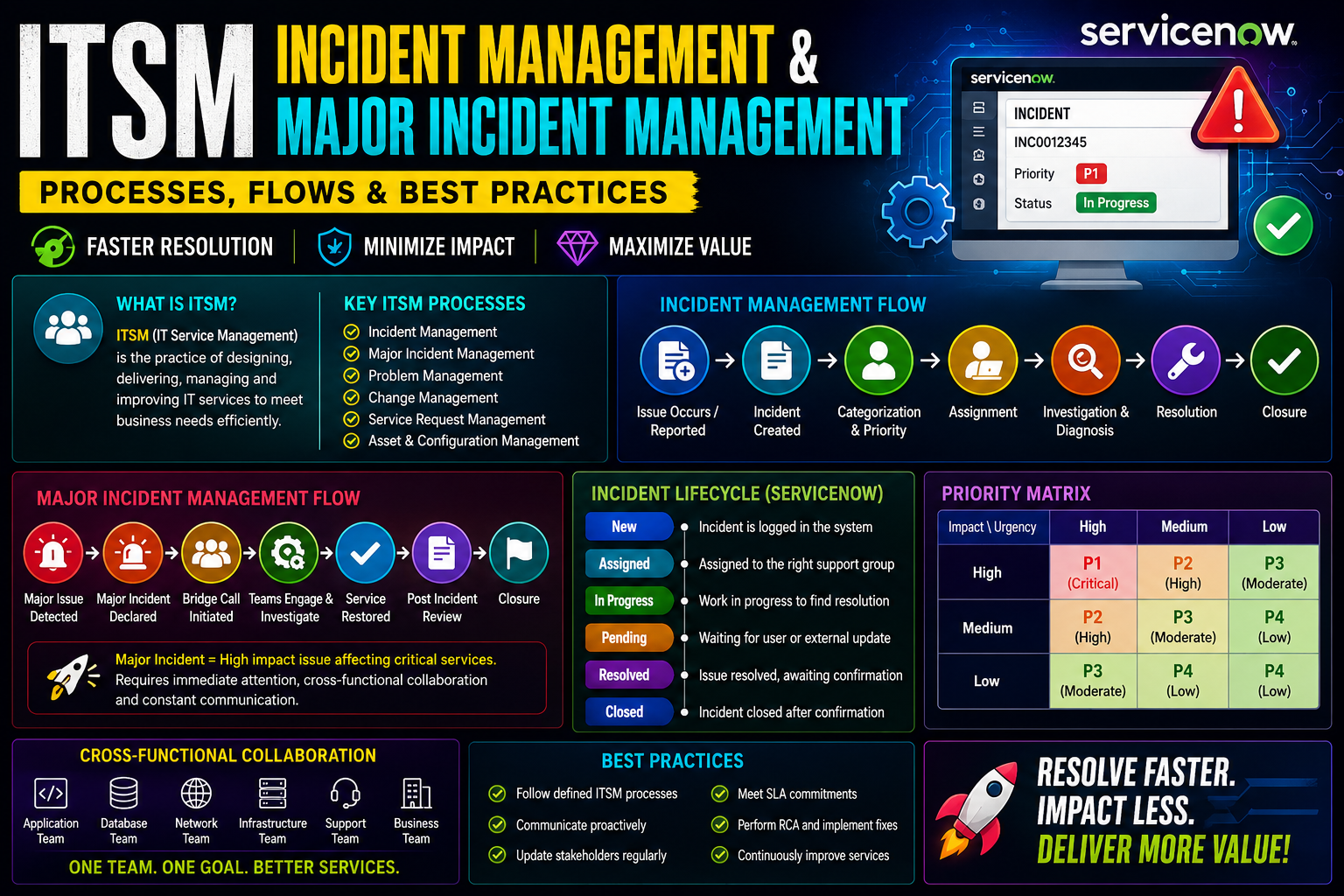
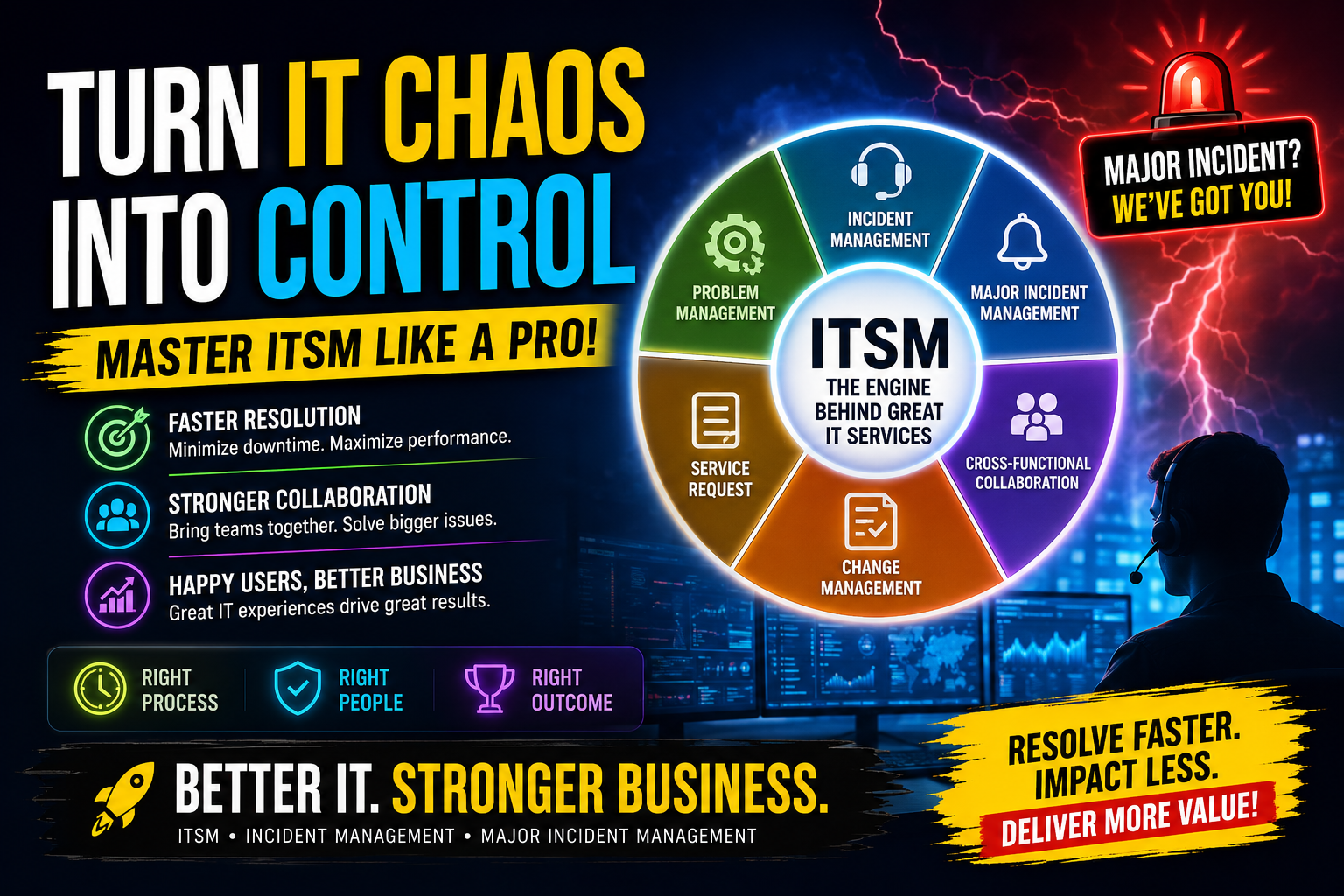
ITSM (IT Service Management) is the practice of designing, delivering, managing, and improving IT services to meet business requirements efficiently.
2. What is ServiceNow?
Answer:
ServiceNow is a cloud-based ITSM platform used for managing incidents, service requests, changes, problems, assets, and workflows.
3. What is an Incident?
Answer:
An incident is any unplanned interruption or reduction in the quality of an IT service that requires restoration as quickly as possible.
Example:
- Application outage
- Failed batch job
- Server down
4. What is Incident Management?
Answer:
Incident Management is the process of restoring normal service operation quickly while minimizing business impact.
5. What is a Major Incident?
Answer:
A Major Incident is a high-priority incident that significantly impacts business operations and requires immediate attention.
Examples:
- Production outage
- Payment gateway failure
- Critical application unavailable
6. Difference Between Incident and Major Incident
| Incident | Major Incident |
|---|---|
| Normal issue | Critical issue |
| Standard SLA | Emergency SLA |
| Limited impact | High impact |
| Single team involvement | Multiple teams involved |
7. What is SLA?
Answer:
SLA (Service Level Agreement) defines the agreed response and resolution times between the service provider and the customer.
Example
| Priority | Response Time | Resolution Time |
|---|---|---|
| P1 | 15 mins | 4 hrs |
| P2 | 30 mins | 8 hrs |
| P3 | 4 hrs | 24 hrs |
| P4 | 1 day | 3 days |
8. What is Priority?
Answer:
Priority determines how quickly an incident should be resolved.
Formula:
Priority = Impact + Urgency
9. What is Impact?
Answer:
Impact indicates how many users, systems, or business functions are affected.
Examples
High Impact
- Entire production system down
Medium Impact
- One department affected
Low Impact
- Single user issue
10. What is Urgency?
Answer:
Urgency indicates how quickly the issue needs resolution.
Example:
- Payroll application down before salary processing = High Urgency
11. What is Escalation?
Answer:
Escalation is the process of involving higher-level support teams when an incident cannot be resolved within defined timelines.
12. Types of Escalation
Functional Escalation
Moving ticket to another technical team.
Example:
L1 Support
    ↓
L2 Support
    ↓
L3 Support
Hierarchical Escalation
Informing management.
Example:
Team Lead
   ↓
Manager
   ↓
Director
13. What is a Bridge Call?
Answer:
A bridge call is a conference call where multiple support teams collaborate to resolve a major incident.
Participants:
- Incident Manager
- Application Team
- Database Team
- Network Team
- Infrastructure Team
14. What is Problem Management?
Answer:
Problem Management focuses on identifying and permanently removing the root cause of incidents.
15. Difference Between Incident and Problem
| Incident | Problem |
|---|---|
| Service interruption | Root cause |
| Immediate restoration | Permanent fix |
| Short-term focus | Long-term focus |
16. What is RCA?
Root Cause Analysis
Answer:
RCA is the process of identifying the actual cause of an incident and recommending preventive actions.
Example RCA Format
Issue:
Application Down

Root Cause:
Database connection pool exhausted

Resolution:
Service Restart

Preventive Action:
Increase pool size and monitoring
17. What is Change Management?
Answer:
Change Management controls modifications made to IT systems to minimize risk and service disruption.
18. Types of Changes
Standard Change
Pre-approved routine change.
Example:
- Password reset
Normal Change
Requires approval.
Example:
- Application deployment
Emergency Change
Urgent fix during production outage.
Example:
- Critical security patch
19. What is CAB?
(Change Advisory Board)
Answer:
CAB is a group that reviews and approves changes before implementation.
20. What Would You Do if a Production Job Fails?
Since you work with JSCH/TAAR-related scheduling, this is important.
Answer:
- Verify job failure.
- Check logs.
- Identify error message.
- Validate dependencies.
- Inform stakeholders if needed.
- Raise incident.
- Restart or rerun job if approved.
- Monitor completion.
- Update ticket.
21. What Would You Do During a Major Incident?
Answer:
- Verify business impact.
- Declare Major Incident.
- Join bridge call.
- Engage support teams.
- Provide regular updates.
- Track actions.
- Ensure service restoration.
- Participate in RCA.
22. What is Cross-Functional Management?
Answer:
Cross Functional Management is the coordination of multiple teams working together to resolve incidents.
Example
Application Team
       +
Database Team
       +
Network Team
       +
Server Team
       ↓
Resolution
23. What Information Should Be Included in an Incident Ticket?
- Short Description
- Impact
- Urgency
- Priority
- Affected Service
- Error Details
- Time of Occurrence
- Resolution Notes
24. What is the Incident Lifecycle?
New
 ↓
Assigned
 ↓
In Progress
 ↓
Pending
 ↓
Resolved
 ↓
Closed
25. Explain a Real-Time Major Incident Example
Sample Answer
During production monitoring, multiple business users reported application unavailability. I validated the issue, raised a P1 incident, notified the Incident Manager, joined the bridge call, coordinated with application and infrastructure teams, provided status updates to stakeholders, and monitored the recovery until services were restored. After restoration, I helped document the RCA and closure activities.
Quick Interview Closing Answer (2 Minutes)
“I have experience working with ITSM processes using ServiceNow. I understand Incident Management, Major Incident Management, SLA tracking, escalations, RCA preparation, and cross-functional coordination. My focus is to restore services quickly, communicate effectively with stakeholders, and ensure incidents are resolved within SLA while contributing to long-term improvements through problem and change management processes.”
 Join now and start building your first project today!
Make the next 30 days the most productive coding days of your life. By the end, you’ll not only understand JavaScript – you’ll be able to build almost anything with it.
Please Join in WHATSAPP GROUP
Please Join in TELEGRAM GROUP
If anyone have interest on GOVT jobs – Please click on this below link
GOVT JOBS